
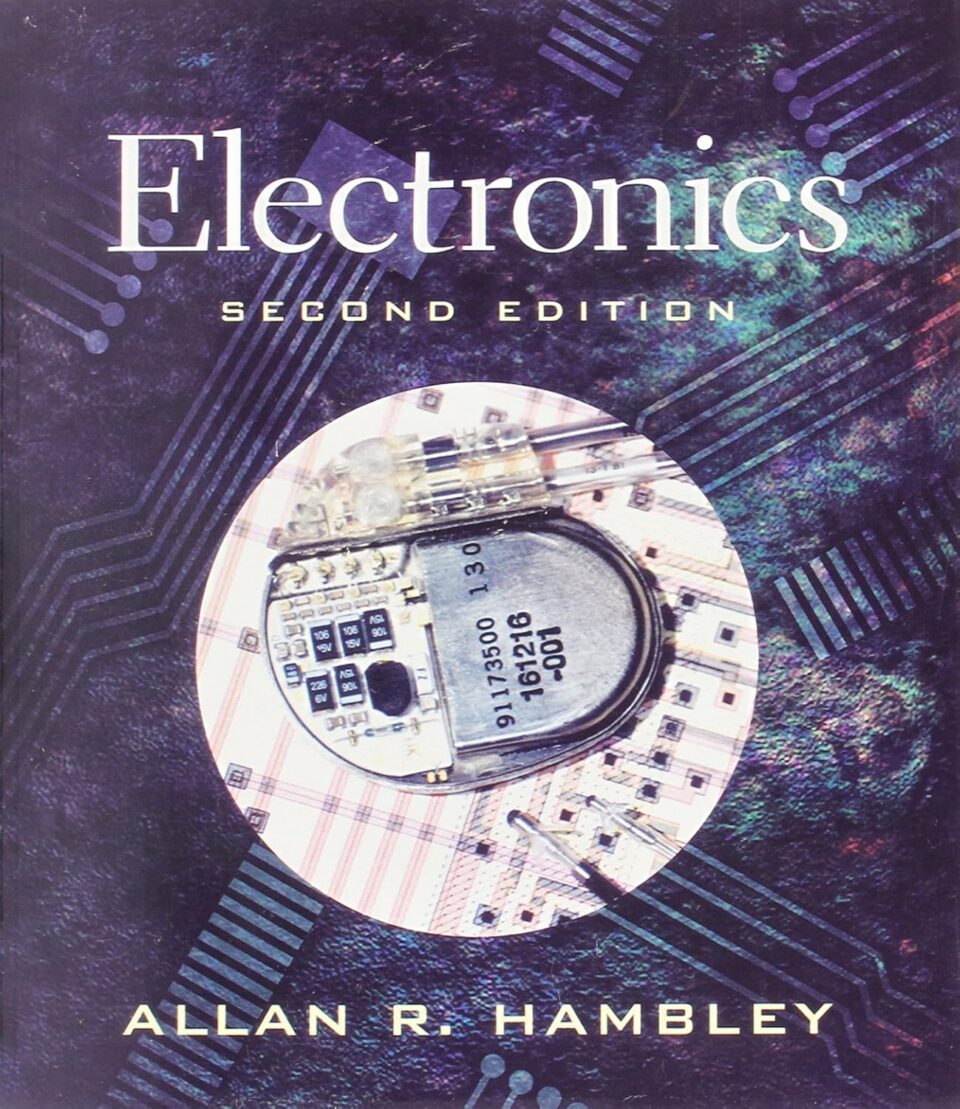
⚡ Comprehensive Review of “Electronics” – The Essential Guide for Engineering Students
📚 Introduction: Why “Electronics” Is a Must-Have Textbook
🔌 For any electrical or computer engineering student, mastering the fundamentals of electronic circuits is crucial. The textbook titled Electronics, published by Pearson, serves as an authoritative resource designed specifically to support core electronic circuits courses. First released in 1999 and currently in its 2nd edition, this comprehensive book spans 912 pages, offering a deep dive into the essential principles and practical applications that students need to know.
📖 The wealth of readily accessible information organized within the book makes it particularly useful as a course companion. Its language and presentation are carefully tailored for English-speaking students, ensuring clarity and accessibility. Whether you’re tackling your first electronic circuits course or revisiting key concepts, this book positions itself as a reliable and thorough guide.
🛠️ In-Depth Content and Course Relevance
📘 Detailed Coverage of Core Electronics Topics
⚙️ Electronics dives deeply into foundational topics essential for electrical and computer engineering curricula. Its rich content addresses the primary building blocks of circuits, enabling students to grasp complex ideas with confidence. Readers will find comprehensive explanations of components, circuit analyses, semiconductor devices, amplifiers, oscillators, and digital electronics, among other crucial subjects.
🔧 This text functions both as a theoretical reference and a practical guide, balancing the technical rigor engineering students demand with the accessibility needed for effective learning. Its comprehensive nature, spanning close to a thousand pages, well equips learners navigating challenging coursework or preparing for exams and future professional applications.
📐 Structured for Effective Learning and Teaching
🎓 The book’s format is conducive to classroom use and self-study alike. Concepts are laid out systematically, progressively building knowledge from basic principles to more advanced applications. Its organization aligns well with typical academic syllabi, which simplifies lesson planning for instructors and study planning for students.
🧩 Additionally, the book includes problem sets, examples, and illustrations that help bridge the gap between abstract theory and practical understanding—critical in electronics education. The inclusion of real-world scenarios allows learners to contextualize their knowledge, enhancing retention and application.
📏 Book Format and Physical Attributes
📚 Physically, Electronics is a substantial volume, weighing approximately 3.6 pounds. The dimensions, 7.9 by 2.2 by 9.2 inches, make it a large textbook that fits comfortably on a desk or in a backpack, though it requires some consideration regarding portability.
📖 With 912 pages, the book offers extensive content while maintaining readability in print form. Its size and heft reflect the depth of material contained within, which many engineering students will appreciate as a thorough resource for their studies.
⭐ Customer Ratings and Industry Reception
🌟 Solid User Reviews Reflecting Practical Value
📝 With a customer rating of 4.0 out of 5 stars based on 23 reviews, Electronics stands as a well-regarded textbook in its niche. While this amount of feedback is modest, it indicates consistent satisfaction among users who rely on it for their academic and practical electronic studies.
🔍 Some reviewers emphasize its clarity and comprehensive nature, describing it as a critical resource for grasping complex electronic circuit theories. The strong alignment with course requirements and thorough explanations are repeatedly praised. This user validation underscores its continued relevance despite the book’s original publication date.
📉 Considerations on Age and Ranking
⌛ It is worth noting that this edition was published in 1999, making it over two decades old. While fundamental electronic principles remain timeless, prospective readers should be aware that cutting-edge technological advancements post-1999 may not be covered. For foundational knowledge and classical circuit understanding, however, it remains an excellent choice.
📚 Ranking-wise, the book holds modest positions in the broader category of books — #1,921,196 overall — but performs better in specialized segments, such as #274 in Circuit Design and #93,400 in Textbooks (Special Features Store). These rankings reflect its niche appeal and focused relevance.
💡 Why “Electronics” Is Valuable for Engineering Students
🚀 The prime value of this textbook lies in its role as a comprehensive instructional resource tailored specifically for students embarking on electronic circuits studies. Its detailed explanations, practical examples, and methodical structure combine to make it an indispensable academic companion.
🎯 Engineering students will find that Electronics meets the needs of both beginners and those seeking to deepen their understanding of circuit topology and behavior. Having a single reference source that spans basic concepts through to more advanced circuit design principles can save time and increase efficiency in study and professional preparation.
🔍 Key Strengths and Potential Limitations
👍 Strengths
- ✔️ Comprehensive coverage of fundamental electronic concepts and practical applications
- ✔️ Well-suited for use alongside core courses in electrical and computer engineering
- ✔️ Clear, accessible language optimized for student learning
- ✔️ Rich with examples and problems to enhance comprehension
- ✔️ Substantial physical volume providing an in-depth reference
👎 Limitations
- ❌ Published in 1999; lacks updates on modern electronic advancements and emerging technologies
- ❌ Large and heavy format may challenge portability for some users
- ❌ Rankings indicate relatively low visibility outside specialized academic circles
⚙️ Conclusion: Who Should Buy This Book?
🎓 Anyone seriously pursuing studies in electrical or computer engineering will find Electronics by Pearson an invaluable asset. This textbook’s thorough, approachable content and its alignment with core curriculum requirements make it particularly well-suited for undergraduate students enrolled in electronic circuits courses.
🌟 Despite its age, this edition remains a highly relevant and trusted source for foundational knowledge. However, those seeking the latest coverage on cutting-edge electronics or advanced emerging technologies should consider supplementing their studies with more current publications to stay abreast of industry trends.
📘 Ultimately, Electronics represents a solid investment in one’s educational journey for mastering the fundamental theories and practical techniques critical to electronics and circuit design.
